Are Moissanite Diamonds Fake? The Honest 2026 Answer
by sensitive stones on Jun 30, 2026
No. Moissanite is not a fake diamond, and it is not a fake anything. It is a real, naturally occurring gemstone made of silicon carbide, almost always grown in a lab today. It is simply not a diamond, which is pure carbon. So moissanite is a genuine stone in its own right, just a different one, sitting alongside diamonds rather than imitating them.
The confusion is understandable. Moissanite looks so much like a diamond that even jewelers reach for a tester to be sure, and it costs a fraction of the price. Below is the honest, no-spin version: what moissanite actually is, why it passes a diamond tester, how to tell the two apart at home, and how it stacks up against lab-grown diamonds, mined diamonds and cubic zirconia.
Is moissanite a real diamond or a fake one?
Moissanite is a real gemstone but not a real diamond. The two are different minerals: moissanite is silicon carbide (SiC), while a diamond is pure crystallized carbon. Because moissanite is its own stone with its own chemistry and its own beauty, calling it "fake" is inaccurate. A fake or simulant is something pretending to be a diamond with none of its own merit. Moissanite stands on its own, with brilliance that often out-sparkles a diamond and a hardness close behind it.
Moissanite was first discovered in 1893 by the French chemist Henri Moissan, who later won the Nobel Prize in Chemistry. He found tiny crystals in a meteorite crater in Arizona and at first mistook them for diamonds. Natural moissanite is so rare that nearly all moissanite in jewelry today is lab-grown, which is exactly what makes it consistent, affordable and conflict-free.
Why does moissanite get called a "fake diamond"?
Moissanite gets the "fake" label for two reasons, neither of which holds up. First, it looks like a diamond, so people assume it is trying to be one. Second, it is sold as an affordable diamond alternative, and anything cheaper than a diamond gets treated with suspicion. But affordability is not the same as fakery. Moissanite is graded, durable and real. It is priced lower because it is grown rather than mined, not because it is a lesser stone.
The short version: moissanite is not imitation jewelry. It is a distinct gemstone that happens to look like a diamond and cost far less.
How can you tell moissanite from a diamond at home?
The fastest at-home tell is the sparkle. Moissanite has a higher refractive index than a diamond (about 2.65 versus 2.42) and more than double the dispersion, so it throws off bold rainbow flashes of "fire," especially in larger stones and bright light. A diamond returns more white light and looks comparatively restrained. Once you have seen the two side by side, the extra colorplay in moissanite is hard to unsee.
Three more checks anyone can do:
- The loupe test: moissanite is doubly refractive, so under 10x magnification you can often see doubled or fuzzy facet edges inside the stone. Diamonds are singly refractive and show crisp, single edges.
- The fire test: tilt the stone under a lamp. Intense, disco-like rainbow flashes lean moissanite. Subtle white sparkle with occasional color leans diamond.
- The paperwork: a moissanite from a reputable seller comes with a GRA report included, listing its specifications. A diamond carries a GIA or IGI grading report. Matching the stone to its paperwork settles most questions.
For the full breakdown of sparkle, hardness and price, see our companion guide, Moissanite vs Diamond: The Real Difference.
Does moissanite pass a diamond tester?
Yes, on a standard tester. The cheap handheld diamond testers sold online measure thermal conductivity, how fast a stone moves heat. Moissanite conducts heat almost as well as a diamond, so high-quality moissanite passes a basic thermal tester as "diamond" the vast majority of the time. This is why a thermal tester alone cannot prove a stone is a diamond.
It does not pass a multi-tester. Moissanite is electrically semiconductive, while most diamonds are not. Modern "multi-testers" or "moissanite testers" check electrical conductivity as well as heat, and they flag moissanite instantly. So the honest answer is: moissanite passes the simple thermal pen, and fails the dual heat-and-electricity tester. A jeweler with a multi-tester or a gem lab can identify it in seconds. The International Gem Society explains the gemstone's properties in more detail in its moissanite reference guide.
How does moissanite compare to lab diamonds, mined diamonds and cubic zirconia?
This is where the "fake" myth really falls apart. Moissanite is not the same as cubic zirconia, the soft glass-like simulant most people picture when they hear "fake diamond." Here is how the four stones line up on the things buyers actually ask about.
| Property | Moissanite | Lab-grown diamond | Natural diamond | Cubic zirconia (CZ) |
|---|---|---|---|---|
| What it is | Silicon carbide gemstone | Carbon, grown in a lab | Carbon, mined | Synthetic simulant (zirconium dioxide) |
| Hardness (Mohs) | 9.25 | 10 | 10 | 8 to 8.5 |
| Sparkle | Extra fire, bold rainbow flashes | Classic white brilliance | Classic white brilliance | Glassy, dulls over time |
| Durability for daily wear | Excellent | Excellent | Excellent | Poor, scratches and clouds |
| Thermal diamond tester | Usually passes as diamond | Passes (it is a diamond) | Passes | Fails |
| Origin | Lab-grown, conflict-free | Lab-grown, conflict-free | Mined | Lab-made |
| Relative price | Lowest of the durable stones | Mid | Highest | Very low, but short-lived |
The takeaway: moissanite and cubic zirconia are not the same thing. CZ is soft, clouds within a year or two and fails a diamond tester. Moissanite is one of the hardest gemstones used in jewelry, keeps its sparkle for life and passes a thermal tester. If anything wears the "fake diamond" label fairly, it is CZ, not moissanite.
Is moissanite worth buying, and does it hold up over time?
Moissanite is worth buying if you want diamond-level presence without diamond pricing, and you want a stone tough enough for everyday wear. At 9.25 on the Mohs scale it is the second-hardest gemstone commonly set in jewelry, after diamond. It resists scratching, will not cloud and does not lose its sparkle with age. A quick clean with mild soap and warm water brings it back to full brilliance, the same care you would give any fine piece.
One honest note on resale: like most gemstones that are not investment-grade mined diamonds, moissanite is bought to be worn, not flipped. Its value is in years of daily sparkle for a fraction of the cost, not in resale. For more on how stone and metal pricing has shifted, see our 2026 price guide.
Is moissanite safe for sensitive skin?
The stone itself is inert and skin-safe, but skin reactions usually come from the metal, not the gem. At Sensitive Stones, moissanite is set in 925 sterling silver finished in 18K white, yellow or rose gold, and every piece is nickel-free and lead-free, so it is hypoallergenic and built for all-day wear. If you have reacted to jewelry before, that is almost always a nickel issue rather than the stone. Our guide to nickel-free jewelry explains what to look for, and if you wear studs every day, see our guide to moissanite stud earrings for sensitive ears.
Moissanite pieces that read like a diamond
Here are some of the styles people most often mistake for diamonds, set in hypoallergenic 925 sterling silver with a GRA report included.
 Classic Moissanite Solitaire Ring
The quintessential "is that a diamond?" ring. A round D, VVS1 colorless solitaire.
View ring →
Classic Moissanite Solitaire Ring
The quintessential "is that a diamond?" ring. A round D, VVS1 colorless solitaire.
View ring →
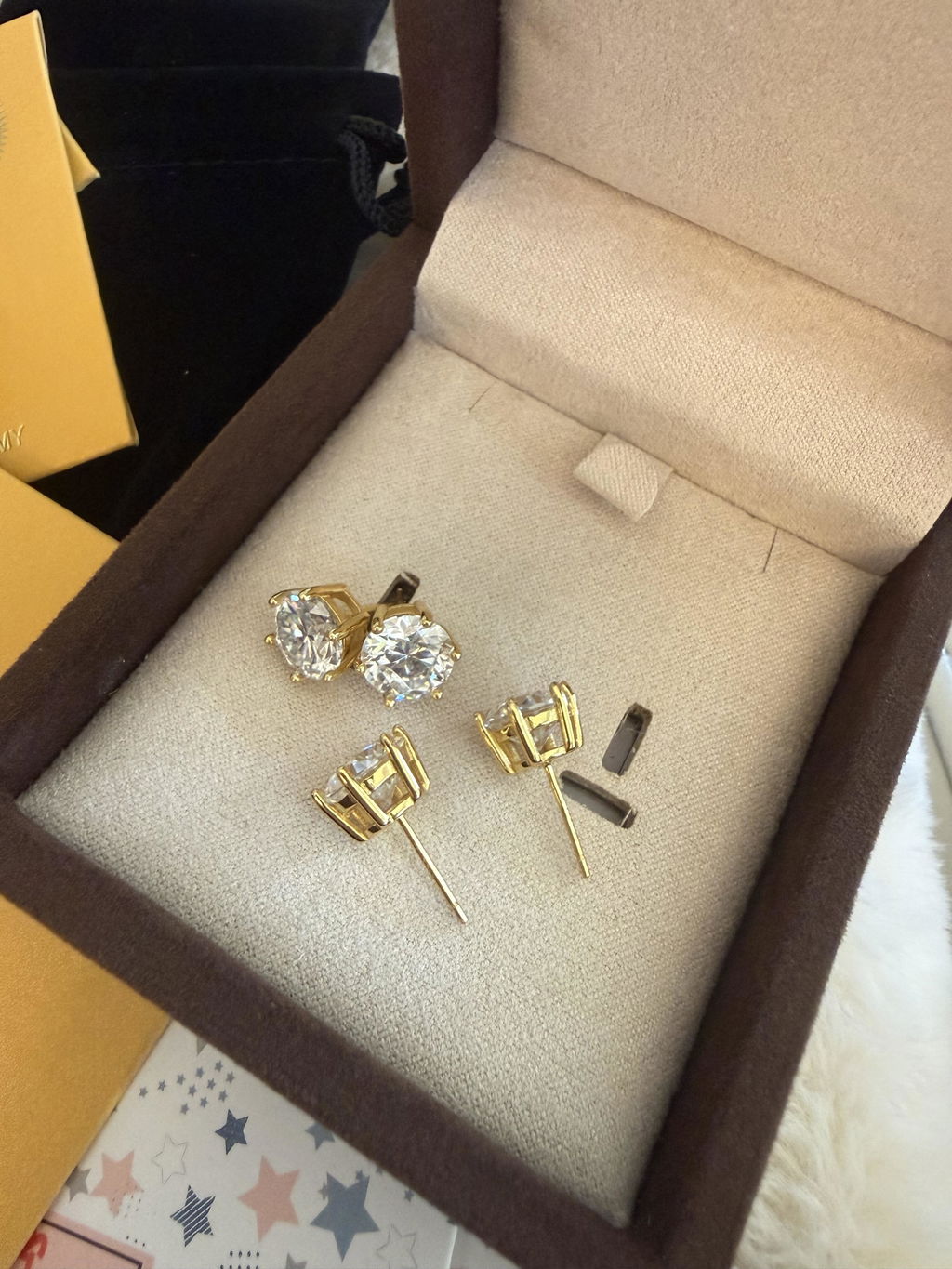
 4-Prong Moissanite Solitaire Studs
Round solitaire studs that read just like diamond studs. Hypoallergenic for sensitive ears.
View earrings →
4-Prong Moissanite Solitaire Studs
Round solitaire studs that read just like diamond studs. Hypoallergenic for sensitive ears.
View earrings →
 White Moissanite Tennis Bracelet
A line of round moissanite that mirrors a diamond tennis bracelet. Unisex.
View bracelet →
White Moissanite Tennis Bracelet
A line of round moissanite that mirrors a diamond tennis bracelet. Unisex.
View bracelet →
 Moissanite Solitaire Necklace, 1 to 5 ct
A single round stone on a fine chain. Choose your carat from 1 to 5 ct.
View necklace →
Moissanite Solitaire Necklace, 1 to 5 ct
A single round stone on a fine chain. Choose your carat from 1 to 5 ct.
View necklace →
Browse the full ranges in moissanite rings, the tennis collection, moissanite earrings and moissanite necklaces. New to moissanite care? See our jewelry care tips.
Frequently asked questions
Are moissanite diamonds fake?
No. Moissanite is a real gemstone, not a fake. It is made of silicon carbide rather than carbon, so it is not technically a diamond, but it is a genuine, durable stone with its own brilliance. "Fake" describes a simulant with no merit of its own, which moissanite is not.
Is moissanite a real diamond?
No, moissanite is not a real diamond. A diamond is pure carbon; moissanite is silicon carbide. They are two different minerals that happen to look very similar. Moissanite is a real stone, just not a diamond.
Does moissanite pass a diamond tester?
Yes on a standard thermal tester, because moissanite conducts heat almost like a diamond. No on a multi-tester, which also reads electrical conductivity and identifies moissanite straight away. So a basic tester alone cannot confirm a stone is a diamond.
How do I tell if a stone is moissanite or a diamond?
Look at the fire. Moissanite throws bold rainbow flashes, while a diamond returns more white light. Under a 10x loupe, moissanite often shows doubled facet edges because it is doubly refractive. A jeweler with a multi-tester can confirm it in seconds.
Is moissanite the same as cubic zirconia?
No. Cubic zirconia is a soft simulant that scratches, clouds within a year or two and fails a diamond tester. Moissanite is far harder at 9.25 Mohs, keeps its sparkle for life and passes a thermal tester. They are very different stones.
Does moissanite lose its sparkle over time?
No. Moissanite does not cloud or dull. It resists dirt, oil and scratches, and a simple clean with mild soap and warm water restores full brilliance. Its fire is a permanent property of the stone.
Is moissanite worth it?
If you want diamond-level sparkle and everyday durability without diamond pricing, yes. Moissanite delivers the look and toughness for a fraction of the cost. It is bought to be worn rather than resold, which suits most buyers perfectly.
The bottom line
Calling moissanite a "fake diamond" sells it short. It is a real gemstone with more fire than a diamond, hardness second only to diamond, a lab-grown and conflict-free origin, and a price that leaves room to actually enjoy it. It is not pretending to be a diamond. It is simply a different, brilliant choice, and for a lot of people, the smarter one.
Ready to see it in person? Explore all moissanite jewelry, or read the deeper comparison in Moissanite vs Diamond: The Real Difference.
Sources
- International Gem Society, Moissanite Jewelry and Gemstone Information.
- Gemological Institute of America (GIA), Synthetic Moissanite: A New Diamond Substitute.
- Encyclopaedia Britannica, Henri Moissan.